By Alex Uspenskyi, Founder, IONI
Alex Uspenskyi is the founder of IONI, the operations and compliance platform food and beverage manufacturers run their floor on. Batches, lots and production data live there, with food safety compliance (FSMA, SQF, BRCGS and HACCP) built in. Learn more about food safety software for manufacturers.
Most small food plants that run an environmental monitoring program (EMP) are good at the first half of it: they swab, they send samples to the lab, and they file the results. The second half is where programs quietly fail. A binder full of “negative” reports tells you the plant passed on the days it was tested. It does not tell you whether a harborage site is slowly building up, whether one drain keeps coming back near the limit, or whether the cleaning change you made in the spring actually worked.
This article covers the second half: how a small team without a microbiologist can turn swab results into a trend it can act on.
Start with a site map people actually use
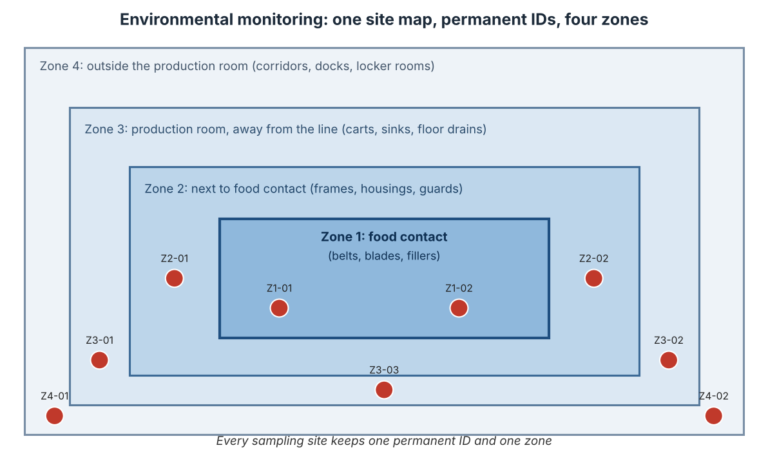
An EMP is only as good as its sampling plan. Before you think about trending, make sure every sampling point is named, numbered and placed on a simple floor plan, and that each one is assigned to a zone.
- Zone 1: surfaces that touch food directly, such as slicer blades, conveyor belts and filler nozzles.
- Zone 2: surfaces close to food contact, such as equipment frames, housings and the outside of guards.
- Zone 3: surfaces further away in the production room, such as carts, hand-wash sinks and floor drains near the line.
- Zone 4: areas outside the production room, such as corridors, locker rooms and loading docks.
Zone naming varies between programs and standards, so use the definitions your auditor and customer expect. What matters is that the same site always carries the same ID. If “Drain 3” becomes “south drain” in one report and “line 2 floor drain” in another, you cannot trend it.
Record more than the result
A bare “negative” or “positive” is not enough to learn from. For each swab, capture the following in the same place, every time:
- Site ID and zone
- Date, time and who collected the sample
- What was running that day, and whether sanitation had just finished or production was mid-shift
- The lab result and the organism or indicator tested
- Any follow-up action, and the result of the re-test
The “what was running” detail is the one most plants skip, and it often explains the result.
Look for patterns, not just failures
Once a few months of results sit in a consistent format, three simple views will tell you most of what you need to know.
- By site: which locations come back positive or borderline more often than others? Repeat hits at the same spot suggest a harborage site, such as a damaged seal, a hollow roller or a drain with poor flow.
- By zone: are results creeping from Zone 3 toward Zone 2? Movement toward food contact surfaces is an early warning, even if nothing has reached Zone 1.
- By time and activity: do positives cluster after certain products, certain shifts, or after maintenance work? That points to a specific cause you can test.
Write the response rules down before you need them
When a result comes back positive, the worst time to decide what to do is that morning. Write down your action rules in advance, and make them proportional to the zone. A typical structure looks like this, though you should align it with your own food safety plan and your regulator or customer requirements:
- A positive in a zone close to food contact usually triggers a deeper clean, a targeted re-swab of that site and the surrounding area, and a review of what changed.
- A positive on a food contact surface usually calls for a much stronger response, including a hold on affected product while you investigate.
- Any repeat positive at the same site should trigger a root cause check, not just another clean and re-swab.
Close the loop on every corrective action
The most common EMP finding in audits is not a missed swab. It is a corrective action that was started and never closed. Make sure every positive result links to a recorded action, a re-test result and a sign-off. If your records live on paper, that link is easy to lose. If they live in a system, the open actions should be impossible to ignore.
Review the program on a schedule
Hold a recurring trend review, monthly for a small plant. Check whether sampling sites still make sense after layout or equipment changes and whether frequency still matches the risk. Add sites when you add equipment, and retire them only with a documented reason.
What to ask of any tool, spreadsheet or binder
Whether you run the program on paper, in a spreadsheet or in software, test it against five practical questions:
- Are swabs scheduled by rule (every shift, after each sanitation, at batch start or close), or do they rely on someone remembering?
- Is the person who collects a result different from the person who reviews it, and does the record show both?
- Can a failed result be quietly changed to a pass? It should not be possible, and any correction should leave a trail.
- Does a failed result automatically open a deviation and a corrective action, so nothing depends on a sticky note?
- Can you pull up the batches and lots that were running when a site went positive? Linking environmental results to production records is what turns a positive into a scoped investigation instead of a guess.
The last question matters most. If a drain tests positive and you can immediately see which batches ran on that line since the last clean result, you can make a proportionate decision about product. If you cannot, every positive becomes a worst-case scenario.
A short checklist to start this month
- Give every sampling site a permanent ID and place it on a floor plan.
- Add “what was running” and “time since sanitation” to every swab record.
- Put all results in one table, so the same site can be sorted across months.
- Write response rules for each zone and get them approved by your QA lead.
- Link every positive to a corrective action, a re-test and a sign-off.
- Hold a short monthly trend review and record who attended.
A good EMP is not about collecting more samples. It is about being able to look back over six months and see, with confidence, whether your plant is getting cleaner or slowly drifting. A consistent record is what makes that possible.
Author bio
Alex Uspenskyi is the founder of IONI, the operations and compliance platform food and beverage manufacturers run their floor on. Batches, lots and production data live there, with food safety compliance (FSMA, SQF, BRCGS and HACCP) built in. Learn more about food safety software for manufacturers.