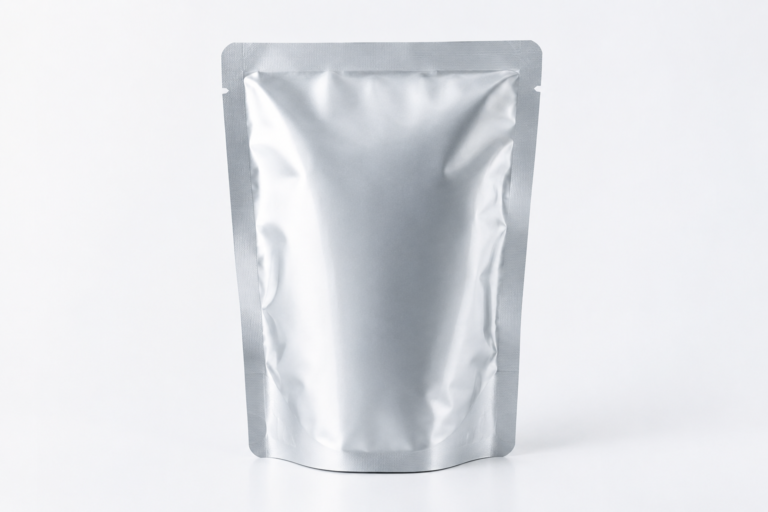
Retort pouch qualification is an important part of food safety for shelf-stable foods packed in flexible packaging. Unlike conventional packaging, a retort pouch must withstand a defined thermal processing cycle, including retort temperature, holding time, pressure, cooling, and handling.
Technical content adapted from material provided for publication. Original technical source attribution: Luna Luo, Chief Executive of J-Origin Packaging, a flexible packaging and label converter based in Shenzhen, China. Image credit: the seal-window diagram accompanying the original article was drawn by J-Origin Packaging and may be reused with attribution.
The packaging material therefore should not be treated simply as a purchasing specification. The retort pouch, seal integrity, laminate structure, and packaging process all need to be considered when establishing and validating a food safety plan.
A pouch may perform well during normal storage but fail during the retort process. For this reason, packaging qualification should be completed using the actual product, equipment, and intended thermal process before commercial production.
1. Start With the Retort Process, Not the Packaging
The pouch should be selected according to the intended retort process. Before requesting packaging samples or approving a supplier, establish the key process conditions.
Important parameters include:
Retort Temperature and Holding Time
The packaging structure must be suitable for the complete thermal process. A structure qualified for a relatively short retort cycle should not automatically be assumed suitable for a longer or more severe process.
Overpressure
Determine whether the retort uses air or another form of overpressure. Pressure changes the mechanical stresses placed on the pouch and should be clearly stated in the packaging specification and supplier request for quotation.
Cooling Method
Cooling conditions can affect pouch deformation and seal integrity. Cooling inside the retort under pressure and cooling in a separate water system can create different mechanical conditions.
Fill Temperature
Hot filling and cold filling followed by retorting can place different demands on the sealant layer and seal area.
Headspace
Headspace should be controlled as part of the packaging and filling specification. Insufficient headspace may restrict product expansion during processing, while excessive headspace can reduce packaging and shipping efficiency.
2. The Retort Pouch Structure Must Survive the Cooking Process
Shelf-life testing evaluates how packaging performs during storage. Retort processing presents a different challenge because the packaging is exposed to elevated temperature, pressure, moisture, and mechanical stress within a relatively short period.
The packaging structure should therefore be evaluated for its ability to withstand the complete retort cycle.
Retort-Grade Sealant
The sealant layer must be suitable for retort applications. A sealant that performs well during conventional form-fill-seal operations may not provide adequate performance during retort processing.
Aluminium Foil and Barrier Properties
Aluminium foil can provide strong protection against moisture, oxygen, and light. However, the foil layer is primarily a barrier layer rather than a structural reinforcement.
Flexing can create cracks or defects in aluminium foil. Transparent high-barrier structures may therefore behave differently under mechanical stress and should be evaluated according to the intended application.
Retort-Grade Laminating Adhesive
The laminating adhesive must be suitable for the intended thermal process.
Poor adhesive performance can result in delamination, where the layers of the laminate separate after retort processing. This type of failure may not be visible before processing but can become apparent after exposure to heat and moisture.
Printing Ink and Ink Adhesion
Printing inks and their adhesion to the packaging structure should also be considered.
Retort processing can expose the printed structure to conditions that reveal problems such as inadequate curing or poor adhesion. Packaging qualification should therefore include inspection of the printed surface and laminate after retorting.
3. Seal Integrity Is a Critical Retort Pouch Safety Factor
For many retort pouch applications, the seal is one of the most critical areas to control.
Two common problems are an incorrectly established seal window and contamination of the seal area.
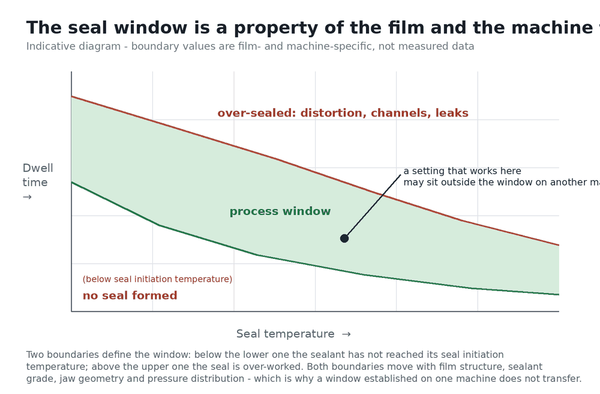
Establish the Seal Window on the Production Machine
Seal temperature, dwell time, and pressure interact with the packaging material. A sealing condition that works effectively on one machine may not produce the same result on another machine.
The seal window should therefore be established using the equipment intended for production.
The validated sealing parameters should be documented and controlled as part of the packaging process.
Prevent Product Contamination in the Seal Area
Food products such as sauces, gravies, oils, and particulate-containing products can contaminate the seal area before sealing.
A seal formed over product contamination may create a weak channel that initially appears acceptable but later develops into a leak.
Seal width and sealing conditions can help manage the risk, but they do not replace effective control of the filling and sealing area.
The cleanliness of the seal zone should therefore be considered when establishing packaging and process specifications.
4. Retort Pouch Documentation to Request From the Supplier
Packaging suppliers should provide sufficient technical information to demonstrate that the proposed structure is appropriate for the intended application.
The specification should include:
- Complete packaging structure, including each layer and its function
- Sealant material and retort suitability
- Seal window and the machine used to establish it
- Barrier test results
- Test temperature and relative humidity for barrier measurements
- Barrier test method and sample area, where applicable
- Burst test results before and after retort
- Creep test results before and after retort
- Delamination assessment after retort
- Seal strength test results
- Leak test method
- Leak test acceptance criteria
A barrier value without its test conditions and test method should not be treated as a complete packaging specification.
5. Test the Pouch Using the Real Product and Retort Cycle
Packaging qualification should simulate actual production conditions as closely as possible.
Testing a pouch filled with water and processed on an approximate retort cycle may not provide sufficient information about how the packaging will perform with the actual food product.
A practical qualification sequence is:
- Fill the pouches using the production recipe or a representative production formulation.
- Use the intended production filler, or equipment that accurately simulates production conditions.
- Process the pouches using the intended retort cycle.
- Include the intended overpressure and cooling conditions.
- Inspect the pouches for swelling, deformation, seal distortion, and delamination.
- Conduct burst, creep, leak, and seal-strength testing on retorted pouches.
- Place representative pouches into storage under defined conditions.
- Re-test the packaging at predetermined intervals to identify failures that may develop during storage.
This approach provides a better understanding of both immediate retort performance and longer-term package integrity.
6. Two Retort Pouch Qualification Problems That Can Appear Later
Packing Pouches While They Are Still Hot
Immediately after retort processing, the pouch seal may not yet have reached its final mechanical strength.
If hot pouches are transferred directly into cases or subjected to mechanical handling, they may be damaged even when they have passed laboratory testing.
Cooling time and post-retort handling should therefore be included in the process assessment.
Changing the Retort Cycle Without Requalification
Packaging qualification should not automatically be transferred when there is a significant change to the process.
Changes to the recipe, retort equipment, retort temperature, holding time, pressure, cooling method, filling equipment, or other relevant process conditions may affect package performance.
When the process changes, the packaging should be reviewed and requalified as necessary.
What Retort Pouch Packaging Cannot Fix
Packaging qualification is an important component of a food safety and quality system, but it has a clear limitation.
A packaging laminate cannot compensate for an inadequate retort process.
If the thermal process is outside its specified or validated conditions, changing the pouch does not make the food process safe.
Packaging qualification demonstrates that the pouch is suitable for the intended process. It does not replace thermal process validation, process control, or food safety verification.
Retort Pouch Qualification Checklist
Before approving a retort pouch for commercial production, food manufacturers and packaging teams should confirm:
- Retort temperature defined
- Holding time defined
- Overpressure conditions defined
- Cooling method defined
- Fill temperature established
- Headspace specification established
- Complete laminate structure documented
- Retort-grade sealant confirmed
- Retort-grade adhesive confirmed
- Ink and print adhesion evaluated
- Seal window established on production equipment
- Seal contamination controls established
- Burst and creep testing completed
- Leak testing completed
- Seal strength testing completed
- Delamination evaluated after retort
- Testing completed using the actual product or representative formulation
- Testing completed using the intended retort cycle
- Post-retort handling evaluated
- Storage testing completed where required
- Packaging requalification requirements defined for process changes
Conclusion
Retort pouch qualification is more than selecting a suitable film or laminate. The packaging must be evaluated as part of the complete food processing system.
The retort cycle, pouch structure, seal window, filling conditions, contamination control, post-retort handling, and storage performance all influence package integrity.
For food manufacturers, the key principle is simple: qualify the pouch against the actual process, not just against a packaging specification sheet.
A properly documented packaging qualification program can help identify seal failures, delamination, leakage, mechanical damage, and other packaging-related risks before they affect commercial production.
Technical content adapted from material provided for publication. Original technical source attribution: Luna Luo, Chief Executive of J-Origin Packaging, a flexible packaging and label converter based in Shenzhen, China. Image credit: the seal-window diagram accompanying the original article was drawn by J-Origin Packaging and may be reused with attribution.