Anannya K writes educational content at SterlingNext about professional training, certification, and management practices. Her articles explain technical concepts in simple language, helping readers connect learning with everyday workplace tasks.
A food safety check has little value if nobody acts on the findings. For example, a worker may spot a torn package when ingredients arrive, but the production team might use those ingredients without knowing about the damage. The problem goes unnoticed even though the check was done. ISO 22000 helps staff deal with food safety issues, including who to tell, where to keep unsafe food, and who should approve work before it starts again, helping staff handle food safely from purchase to delivery.
What a Food Safety Management System Does
Every day, food business organizations have to check deliveries, clean workspaces, examine equipment, and manage products. These activities may not be effective if the workplace managers adopt a non-integrated approach and treat them as separate processes.
ISO 22000 helps bring these activities together. It helps staff understand their duties, follow the same process, and record important details. This makes it easier to spot problems and check whether food safety practices are working as expected.
For example, checking a chilled delivery should involve more than writing down its temperature. The employee also needs to know:
- What conditions make the delivery acceptable?
- Where to place ingredients awaiting a decision?
- Which staff member checks the delivery and makes the final decision?
- What information do staff need to provide?
Straightforward instructions let staff know what to do, even when they are busy or when new people replace existing staff.
How ISO 22000 Helps Teams Identify Food Safety Hazards
A bakery that uses nuts requires different safety precautions than a catering kitchen that prepares cold foods. Different levels of safety precautions should be taken depending on what products are being made, the ingredients used in those products, and the processes used during the production of these products.
Identify What Could Go Wrong
Food safety hazards may include biological, chemical, allergen, and physical contaminants. The staff must be able to identify how such hazards could enter the food and if they could potentially multiply during storage or preparation.
The team should check each stage of the work, from receiving ingredients to preparing food and cleaning equipment. Workers who do these tasks can help spot possible problems.
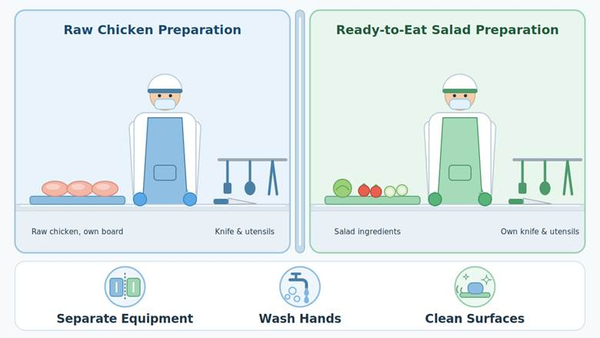
Practical example: A sandwich shop makes chicken fillings and fresh salads. Staff sometimes use the same area to prepare both. This can spread germs from the chicken to the salad. Checking how food is prepared can help find this problem before it reaches customers.
Choose Controls That Match the Risk
Hazard analysis findings guide the choice of controls. These may include separation, controlled cooking, cooling, or foreign material detection.
The business should establish whether selected measures can achieve their intended purpose. Copying another company’s checklist does not show that the measures suit its own products, equipment, or working conditions.
Build Reliable Hygiene and Operating Practices
Cooking food properly is not enough if it gets contaminated later. Dirty tools and poor handling can make food unsafe, even after cooking.
Prerequisite programs cover the basic practices that support safe operations. Depending on the business, these include:
- Keep work areas and equipment sanitary
- Wash hands before preparing food
- Prevent pests
- Test equipment
- Use preferred suppliers
- Dispose of waste materials properly.
These tasks need to be done on a daily basis, as well as regular checks to ensure that everything is in order.
For example, the bakery has separate tools for the products with and without nuts in one drawer. Labeled storage can help avoid mixing. The staff needs supplies and instructions. The supervisors should check cleaning activities.
Give Staff Clear Responsibilities and Communication Steps
A safety task can be neglected if each of the two employees assumes that the other will perform it. The requirements of the ISO 22000 are likely to assist companies in establishing roles and communication procedures.
Each important activity should have an assigned person and a backup in case they are absent. Employees should know who checks results and who can hold products or stop an operation.
Ingredient changes also need attention.
Practical example: Purchasing orders a replacement sauce because the usual product is unavailable. The replacement has an allergen the original didn’t have. Before using the product, the revised ingredient information should be shared with those reviewing recipes, methods, and labels.
Training in ISO 22000 fundamentals can help staff understand their responsibilities. Practical exercises should also cover what to check, whom to contact, and what to do while waiting for a decision.
Monitor Controls and Respond When Problems Occur
Food safety monitoring should provide useful information while there is still time to respond. Checks need suitable methods, clear acceptance criteria, and reliable equipment.
Check Whether Controls Are Working
The following examples show how observations can lead to decisions. They are illustrations, rather than fixed procedures for every business.
| Situation | Practical check | Possible response |
| Chilled ingredients arrive | Check temperature and packaging condition | Hold the delivery if acceptance criteria are not met |
| Refrigerated storage becomes too warm | Review readings and equipment condition | Assess affected food and investigate the equipment |
| An ingredient changes | Check the new specification | Review allergens, instructions, and labels before use |
| Equipment shows damage | Inspect food-contact parts | Stop use and assess possible product contamination |
Address the Problem and Prevent Its Return
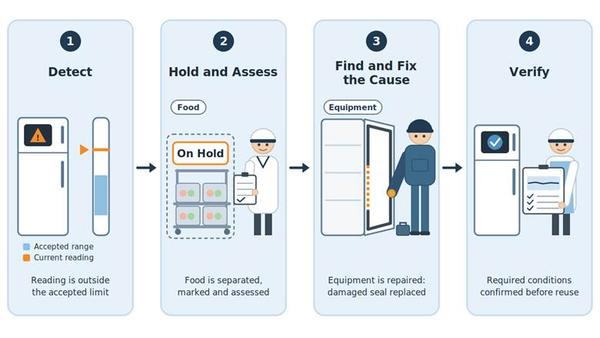
An immediate correction deals with the detected issue. Corrective actions address its cause.
For example, staff may move food from a fridge that is not working properly. Later, they find that the door seal is damaged. Fixing the seal and checking the fridge regularly can help stop the same problem from happening again.
Corrective actions should have an owner, a completion date, and a follow-up check. Closing a maintenance request is not enough if temperatures continue to rise.
Use Audits and Reviews for Continual Improvement
Food safety audits can help businesses ensure that staff members are complying with the written guidelines. An auditor can observe the process of food deliveries, review the documents of rejected food items, or interview workers about the procedures for reporting faulty equipment. ISO 22000 helps organizations by providing a methodology for following up on the results of audits to enhance food safety.
It is beneficial for the team to ask some questions to identify whether the corrective actions were properly implemented. Therefore, the revision of the corrective action plan should include several key questions, namely:
- Have the incidents happened previously?
- Are there enough staff members to ensure the rules are followed during peak times?
- Have corrective actions been taken in a timely manner?
- Has the implemented solution actually resolved the problem?
For example, if staff members often fail to fill out a particular section on a delivery form, the corrective solution will include redesigning the form and providing instructions for completing it. Then, the revised forms should be reviewed to ensure that the issue has been resolved.
Conclusion
The ISO 22000 management system assists food producers in controlling safety at all stages, from the inspection of incoming materials to the proper storage and handling of the product. However, the key to success is the reaction to incidents and the implementation of measures that improve the quality of food and ensure consumer safety through audits and regular checks.
Author Bio
Anannya K writes educational content at SterlingNext about professional training, certification, and management practices. Her articles explain technical concepts in simple language, helping readers connect learning with everyday workplace tasks.