
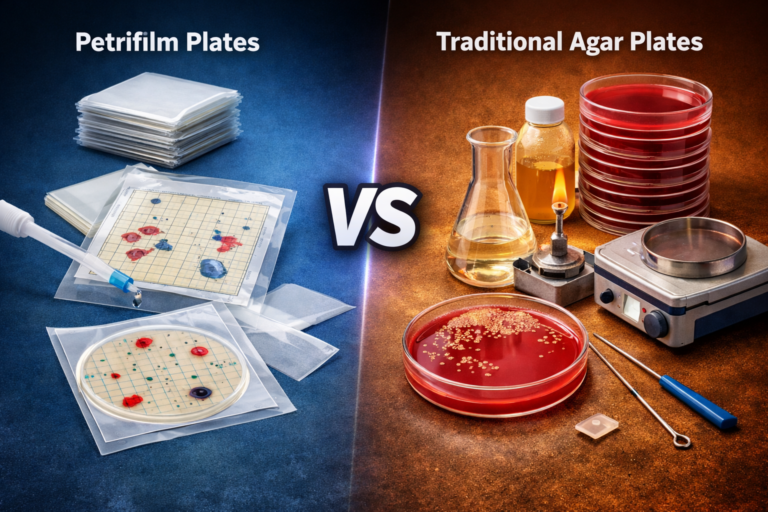
Petrifilm Plate Testing in microbiology and food safety analysis is everything. For decades, traditional agar plates have been the cornerstone of microbial testing, but modern laboratories are increasingly turning to Petrifilm plates as a faster and more consistent alternative.
If you’re curious about how these plates work, why they are preferred in many labs, and how they improve efficiency over conventional methods, this blog will walk you through everything you need to know.
What are Petrifilm Plates?
Petrifilm plates are ready-to-use microbiological testing tools designed to detect and enumerate microorganisms in a variety of samples, including food, beverages, and environmental swabs. Unlike traditional agar plates, which require media preparation, sterilization, and pouring, Petrifilm plates come with a pre-poured nutrient medium and a gelling agent embedded in a compact film.
This design eliminates a lot of preparation work, reduces contamination risk, and simplifies the entire microbial testing workflow. Essentially, Petrifilm Plate Testing allow you to “drop, spread, incubate, and count,” making them ideal for labs looking for speed, consistency, and ease of use.
How Petrifilm Plates Work
Using Petrifilm Plate Testing is straightforward:
- Sample Application – Place a small sample directly onto the plate.
- Top Film Covering – The plate comes with a top layer, which is pressed to spread the sample over the nutrient medium.
- Incubation – The plate is incubated under conditions suitable for microbial growth.
- Colony Observation and Counting – Microbial colonies grow directly on the film, often highlighted with color indicators, making them easy to count without removing the cover.
Advantages over Traditional Methods
Petrifilm plates have several advantages over conventional agar methods:
1. Time Efficiency
Traditional agar preparation involves multiple steps: media mixing, sterilization, pouring, solidification, and careful handling. Petrifilm plates arrive ready-to-use, eliminating preparation and reducing hands-on time.
2. Consistency and Reliability
Uniform thickness and composition of the nutrient medium ensure that results are reproducible, reducing variability that often arises with manually poured agar plates.
3. Space and Resource Saving
Petrifilm plates are compact and stackable, making them perfect for labs with limited incubator space or storage. They also require fewer resources like flasks, agar powder, and autoclaves.
4. Reduced Contamination Risk
Fewer handling steps mean fewer chances for contamination. The pre-packaged film design provides a controlled environment, which is especially helpful in high-throughput labs.
5. Simplified Colony Counting
Many Petrifilm plates come with grids or color indicators that make colony counting easier. Some laboratories even use imaging systems or automated readers to speed up enumeration while maintaining accuracy.
6. Ease of Use
The method is straightforward, requiring minimal specialized training, which helps reduce technician errors and allows labs to scale up testing efficiently.
Applications – Petrifilm Plate Testing
Petrifilm plates are highly versatile and widely used across different industries:
- Food Safety Testing – Detecting bacteria like E. coli, Salmonella, or Listeria in food products.
- Beverage Industry – Monitoring microbial quality in juices, milk, and other beverages.
- Environmental Monitoring – Swab testing surfaces in manufacturing plants or hospitals.
- Quality Assurance – Routine checks for hygiene and compliance in production facilities.
Their versatility, speed, and reliability make them a top choice for labs that need frequent and accurate microbial testing.While Petrifilm plates offer numerous advantages, traditional agar plates still have their place in research and specialized testing. Consider these factors:
| Factor | Petrifilm Plates | Traditional Agar Plates |
|---|---|---|
| Preparation | Ready-to-use, minimal prep | Media prep, sterilization required |
| Hands-on Time | Low | High |
| Flexibility | Limited to available pre-formulated plates | Fully customizable media |
| Space Requirement | Compact, stackable | Requires incubator space for multiple plates |
| Standardization | High reproducibility | Variable depending on preparation |
| Training | Minimal | Requires skilled technicians |
| Contamination Risk | Lower | Higher due to multiple handling steps |
Labs often choose Petrifilm plates for routine, high-volume, and standardized testing, whereas traditional agar plates are still preferred for specialized media requirements, detailed research, or colony morphology studies.
How to use Petrifilm Plate Testing?
- Store plates in cool, dry conditions to maintain shelf life.
- Ensure samples are properly diluted to prevent overcrowded colonies.
- Follow incubation guidelines for temperature and duration specific to the microorganism.
- Use colony counters or digital imaging for high-throughput laboratories.
- Train staff on proper handling to maximize reliability and minimize errors.